

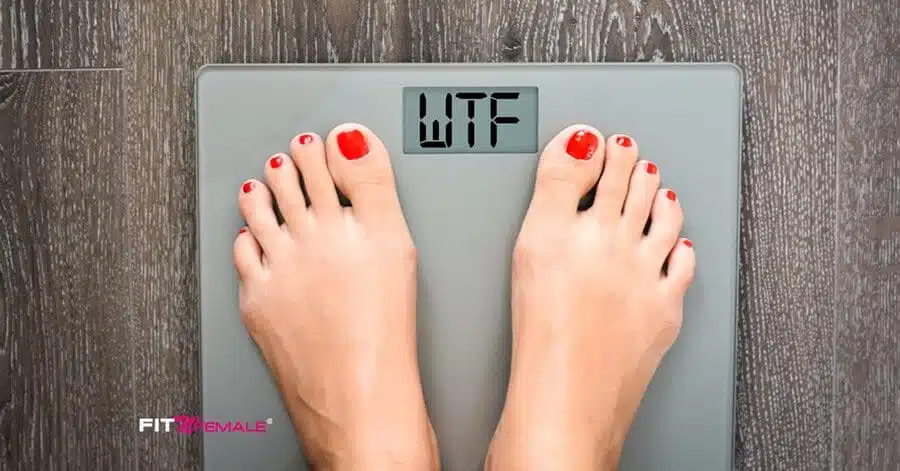
Even though it seems relatively simple, the Fat loss But this is arguably the hardest goal to achieve in the fitness world. This is especially true if we already have a relatively low body fat percentage and are simply trying to lose a little more to reach our peak physique. While the desire to achieve this goal is anything but unhealthy, many women resort to very unhealthy methods to kickstart fat loss when the traditional approach of exercise and a healthy diet no longer works. These dubious methods range from excessive cardio training and crash diets that barely provide any nutrients to potentially dangerous dietary supplements.
Surely there must be a better way to achieve the set goals without such dangerous experiments, right? That's right, there is.
Accordingly, in this article we want to look at a few tricks that will help you to create a Weight plateau to overcome it in a healthy way and without crash diets.
Count your calories
Read on before you panic, because calorie tracking isn't as bad as it seems. To be clear: objective data about your calorie and nutrient intake is extremely important, as it helps you identify the reasons why your weight loss isn't progressing as you'd like. The most common problem is simply that you're eating too much. Especially if your diet has been going on for a while and you've already lost a significant amount of weight, your body's calorie expenditure will have decreased. So, if you now maintain your calorie intake at the same level as at the beginning of your diet, the calorie deficit will gradually decrease. This also reduces fat loss until your weight eventually plateaus completely. Another reason could be that you always eat when you feel hungry, thus consuming more calories than you actually need for fat loss. As you can see, it definitely makes sense to track your daily calorie intake. You no longer need to keep a cumbersome notebook, as the iOS and Android app stores now offer numerous apps to help you monitor your calorie intake. This is particularly easy with apps linked to a product database, so that not only calories but also the amounts of carbohydrates, proteins, and fats consumed are directly recorded. With the help of a calorie counter, you'll easily spot those little and big indulgences, even if they only amount to 200-300 calories a day. In the long run, these calories make the difference between fat loss and plateauing. However, be careful not to let your calorie deficit become too large. Conversely, this will also prevent further weight loss, as your body will switch to starvation mode.
Adjust your nutrient distribution
Besides adjusting your calorie intake, adjusting your macronutrient distribution can also significantly influence whether you continue to lose weight or not. For example, it has been proven that a very high-protein diet is the most effective way to lose fat, regardless of how many carbohydrates or how much fat your diet ultimately contains. Therefore, make sure that a good portion of your diet consists of high-quality protein sources such as lean meat, fish, and dairy products. According to studies from Vanderbilt University, McMaster University in Canada, and the University of Copenhagen, animal proteins in particular help to preserve as much muscle mass as possible during fat loss. As a rule of thumb for protein consumption, you should aim for 1.5 to 2 grams of protein per kilogram of body weight per day, which corresponds to approximately 25-30 percent of your total calorie intake, depending on your calorie needs. Building on this foundation, you can experiment with fat and carbohydrates. Since every body is different, there's no one-size-fits-all solution when it comes to the balance of carbohydrates and fats. Blindly recommending an extreme low-carb diet makes little sense, as some people respond better to it than others. However, there is one rule of thumb for adjusting fat and carbohydrate intake: always consume at least 0.8 grams of fat per kilogram of body weight per day. This is important because your body urgently needs fats to produce hormones and enzymes, among other things. If you reduce your fat intake too drastically, your metabolism won't function optimally. Even worse, your body will stop releasing fat from its stores because it's essential for survival, and it will realize it's no longer getting enough from food. So, if you're stuck on a weight plateau, you can certainly try slightly reducing your carbohydrate intake and increasing your fat intake, or vice versa. And remember: no single macronutrient is inherently bad. It's primarily about the calorie balance and the quality of the nutrients.
Ensure more (intelligent) movement
Simply increasing the amount of exercise isn't possible for everyone, as the time we have available each day is limited. It's more about integrating exercise into our daily routines much more intelligently. You can achieve this, for example, by replacing your conventional "slow and steady" cardio training with high-intensity interval training (HIIT). This form of interval training involves alternating short, high-intensity bursts of activity with cool-down phases, resulting in a workout that burns more calories in half the time. Since HIIT is a very complex topic and there are many different ways to structure it, we refer you to our numerous articles on the subject. If you aren't already doing so, you should also start strength training. This kills two birds with one stone, as you not only burn calories directly during the workout itself, but also during the overall physical activity. The additional muscle mass you build not only gives your body an athletic physique, but also burns extra calories. This is because every gram of muscle requires energy, even at complete rest, without any movement. If that's not an argument for strength training, what is? After all, what could be better than burning calories by doing absolutely nothing on the couch?
Work on your lifestyle
Besides diet and exercise, there are of course other factors in your life that can have a significant impact on weight loss. One of these factors is sleep duration. Consistently getting too little sleep has a very negative effect on fat loss, as has been sufficiently proven by numerous studies. This unpleasant side effect of a workaholic lifestyle is partly due to the fact that your body releases larger amounts of the stress hormone cortisol, which slows down fat burning. It's particularly important to note that a persistently elevated cortisol level also promotes the accumulation of additional body fat, especially around the abdomen and hips. This is, of course, especially frustrating. Therefore, make sure you keep your cortisol levels under control by getting enough sleep. Between 7 and 9 hours of sleep per night is ideal. Of course, it's not a problem if you occasionally fall below this threshold, but it shouldn't become a habit.
A few concluding remarks
Even if you're so motivated after reading this article that you'd love to implement all the tips at once, you should start by implementing one measure. Then, observe your physical progress for a few weeks and decide whether you need to make further adjustments. The major exception, however, is addressing any existing sleep deficit, as you absolutely must not underestimate the impact of insufficient sleep on fat loss and your overall physical health. Of course, it's also crucial that you feel good about yourself during your diet. Therefore, it makes perfect sense to question yourself and your goals. Consider whether it's truly worthwhile to make disproportionately high sacrifices in terms of quality of life for that last percentage point of body fat you want to lose. If you can answer this question with "yes," then nothing stands in the way of your progress, and we wish you every success. However, if you come to the conclusion that this last percentage point isn't worth the extra effort, then have the courage to pull the plug. Ultimately, you don't have to prove anything to anyone, you just need to feel comfortable in your own skin.




 Home
Home WEIGHT LOSS & SHAPING
 FITNESS & ENERGY
 Glow & Wellbeing
 Bundle Deals
 SHAKER & MORE
 DISCOVER
 Shakes
 Collages
 Booster & Focus
 Sated & Slim
 All products