

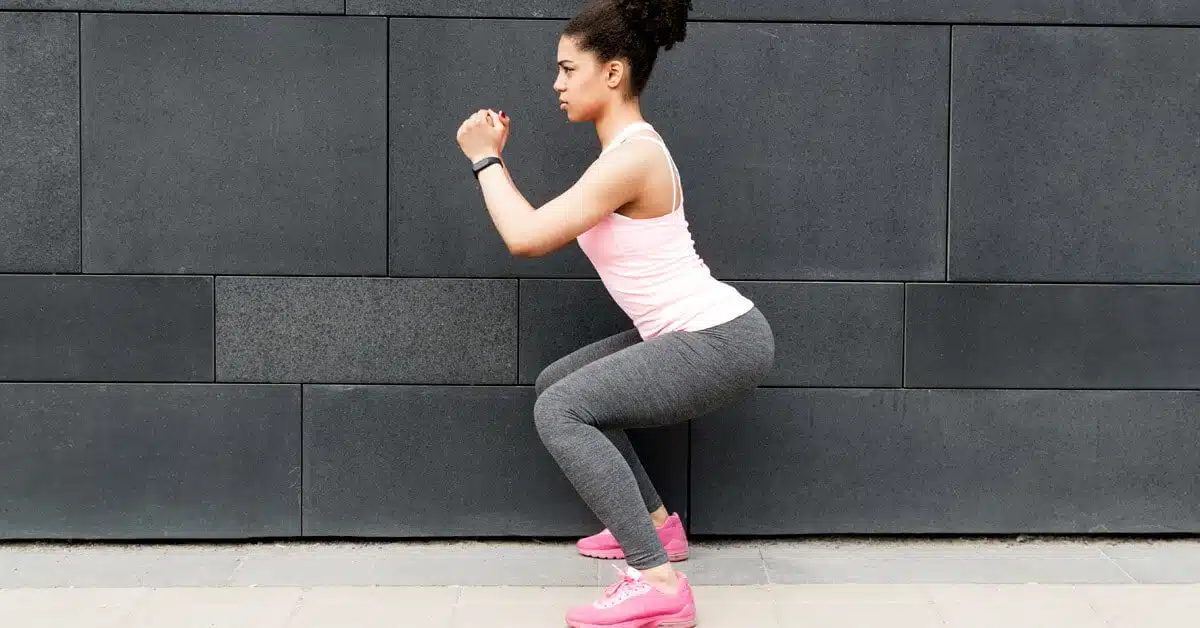
Both Squats (in German: Kniebeugen) It's crucial that you lower your buttocks as much as possible. Only then can you fully engage and strengthen your muscles. It also makes your buttocks very strong, which automatically makes them look sexy.
Many people eventually wonder why they can't increase the weight they lift. There are many reasons. Here's a brief overview of what your squats say about you.
1 - You're bending your upper body too far forward.
If you bend too far forward when squatting and your chest comes too close to your knees, you likely have weak muscles in your hamstrings and glutes. To compensate, you shift your weight forward, allowing your stronger quadriceps and back muscles to do most of the work—especially overcoming the "Q-angle" between your hips and knees. It's quite common for women to focus on their quadriceps. Many women tend to neglect their hamstrings. If this is the case for you, you need to ensure your back muscles receive just as much attention in the future.
Here's how you can do it
- Stretching: You need to stretch your hip flexors. Hip mobility is a key factor in determining how deep you can squat.
- Exercises without added weights: Incorporate seated box squats into your training program more often, using only your own body weight. This way, you can get a feel for your body and learn the correct technique for full squats. When you're ready to use weights, take it slowly. Quality always comes before quantity.
- Weight training: Alternate your front squats with the more challenging overhead squats. It's very difficult to lean your torso forward when your weight is on your heels and you have to be careful not to fall over.
2 - You move your buttocks too much when you squat.
The "butt wiggle" is very common. It occurs when you squat too quickly. Consequently, you automatically try to put excessive strain on your back and knees. As a result, you won't be able to significantly increase the weight because you'll suffer from back pain.
The main reasons for the "butt wink" are improper execution of squats, tight thigh muscles and a weak lower back.
Here's how you can do it
- Stretching: Stretch your hamstrings and adductors.
- Exercises without additional weights: Intensify your waist training, which includes exercises for the lower and upper abdominal muscles, for the lateral muscles and especially for the lower back (back extensors in any form, etc.).
- Weight training: Do your squats with a gym or medicine ball between your back and a wall. This will help you control your gluteal movements because the ball will force you to wobble less.
3 - Your heels are not on the ground
Many people struggle with their balance during squats, even though they keep their chest relatively upright. This problem usually stems from the small muscle called the soleus. Additionally, your calves can contribute to instability during the squat.
Here's how you can do it
- Stretching: Stretch the soleus muscle.
- Exercises without additional weights: The balance exercise, in which you bend one leg backward and your upper body forward to bring both into a line parallel to the floor, is ideally suited.
- Weight training: Use single-leg squats. Hold onto a door frame or piece of equipment with one hand and use a dumbbell in the other hand to perform the exercise.
4 - The knees are being moved too much
Many beginners struggle with excessive knee movement when lifting any weight. This is common in both women and men, as they initially struggle to overcome the dreaded Q-angle. The reasons for this usually lie in insufficient muscle strength in the inner and hamstrings. Furthermore, these small knee movements are intended to compensate and maintain body stability despite the difficulties.
Here's how you can do it
- Stretching: Stretch your adductors before your workout.
- Exercises without added weights: Wrap a resistance band around both knees and walk sideways. The exercise may look silly, but it's very effective.
- Weight training: Do the squats with a ball between your back and a wall, this time using a barbell. Remember when standing up: Keep your knees straight and push them forward.
5 - You're not going down deep enough
This is the cardinal sin of squats. There are many reasons why you might not be able to squat deep enough. If this happens to you, do a weightless exercise. Get yourself to about halfway down (relatively close to the bottom). Now squat all the way down, and then extend your arms horizontally to your sides. If your body tries to spring back up or you can no longer hold yourself up without assistance, your hips are too stiff.
Here's how you can do it
- Stretching: Take a foam roller and exercise to stretch your hamstrings, hamstrings, sartorius, and IT band.
- Exercises without added weights: Go to the Smith machine, adjust the bar to hip height, and step over it several times with your legs one at a time ("bar step-overs"). This exercise opens your hips and is a good warm-up for squats.
- Weight training exercises: Kettlebell swings are ideal because they not only work your glutes, but also open up your hips and improve mobility.
Whey protein
The protein supports muscle building and recovery after training. It is available in 6 delicious flavors. Whey protein is the most popular supplement in fitness.
Whey protein

 Home
Home WEIGHT LOSS & SHAPING
 FITNESS & ENERGY
 Glow & Wellbeing
 Bundle Deals
 SHAKER & MORE
 DISCOVER
 Shakes
 Collages
 Booster & Focus
 Sated & Slim
 All products